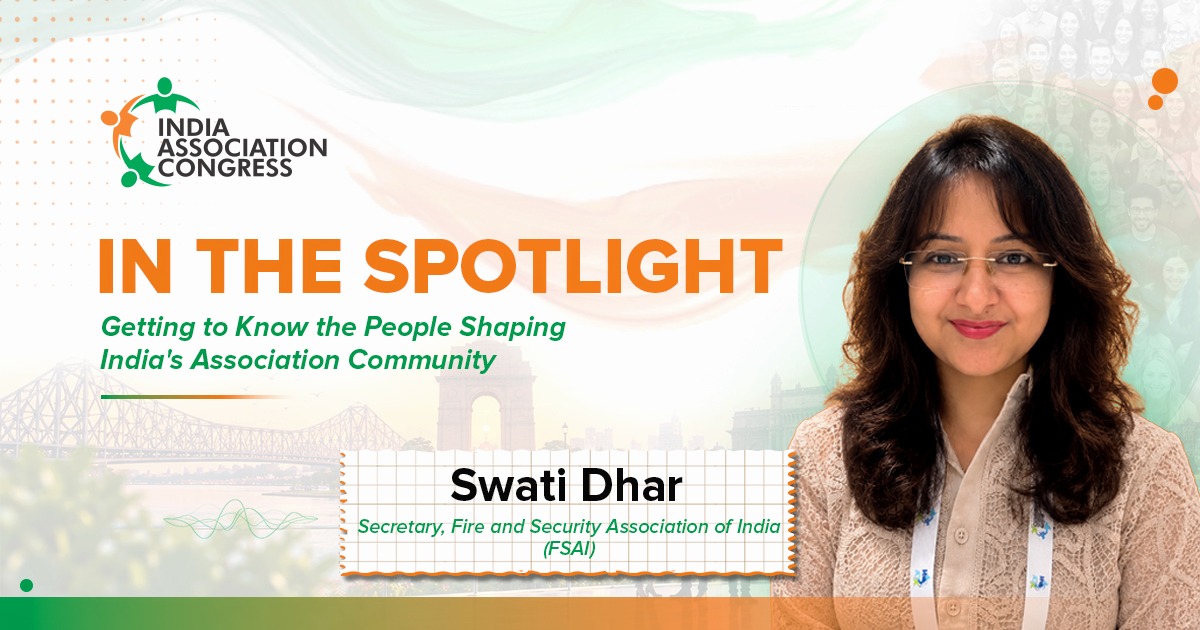
An IAC conversation with Swati Dhar, Secretary, Fire and Security Association of India (FSAI)
Industry associations play an important role in bringing businesses, professionals and other stakeholders together around shared interests. Beyond representing their members, they can contribute to knowledge-sharing, industry collaboration and dialogue on issues affecting their sectors.
In this edition of In the Spotlight, we speak with Swati Dhar, an IAC Advisory Board member associated with the Fire and Security Association of India (FSAI), about the evolving role of industry associations, the value they create for members and how they can strengthen their contribution to India's industrial and social development.
Industry associations often serve as a bridge between businesses, technical experts, regulators and policymakers. From your experience in the fire and safety sector, how can associations make this role more effective?
When it comes to fire and life safety, no single stakeholder can achieve the desired results alone. Businesses bring experience, technical experts bring knowledge, regulators provide direction, and policymakers create the framework. The real impact happens when all these stakeholders come together with a common purpose: protecting lives, safeguarding property and building a safer society.
This is where industry associations can make a real difference. In my view, they should go beyond networking and representation to become active partners in policymaking, knowledge-sharing, industry development and the promotion of a strong safety culture.
Beyond networking and industry events, what practical value should an industry association deliver to its members to remain relevant and engaged?
I believe an industry association should be much more than a platform for networking and industry events. It should be an organisation that creates real opportunities, solves practical problems and helps its members grow.
From my perspective in the fire and safety sector, there are five key areas where an association can deliver meaningful value.
Knowledge and technical support: Associations should keep members updated on the latest fire safety regulations, NBC provisions, BIS standards, government notifications and technological developments through regular technical sessions and practical guidance.
Business development opportunities: They should help members connect with potential clients, consultants, architects, builders, facility management companies and government departments. The objective should be to convert networking into genuine business opportunities.
Representation and advocacy: An association should act as a strong collective voice for the industry, bringing members' concerns to regulators and policymakers, promoting fair business practices and helping address challenges related to compliance and implementation.
Skill development and professional recognition: Training programmes, certification initiatives, workshops and knowledge-sharing sessions can help members upgrade their technical expertise and build credibility in the market.
Support for small and medium-sized businesses: Not every member has access to the same resources. Associations can provide guidance on regulatory compliance, emerging technologies, business management and new market opportunities, helping smaller businesses compete and grow.
However, I believe the most important factor is accountability. Members should be able to see tangible outcomes from their participation, whether through new business connections, technical guidance, professional development or effective representation.
In a sector where safety standards and public awareness are so important, how can associations help translate industry expertise into greater awareness, stronger practices and meaningful change?
In our sector, knowledge can save lives, awareness can prevent disasters, and the right practices can protect entire communities. But for that to happen, we must take fire safety beyond technical discussions and bring it into people's everyday lives.
I would like to conclude with one thought: Fire safety is not just about equipment, regulations or compliance; it is about protecting lives. And an association's greatest achievement is not simply the awareness it creates, but the accidents it helps prevent and the lives it helps save.
Fire and safety concerns intersect with sectors such as construction, infrastructure, hospitality and manufacturing. How can associations build stronger partnerships across industries to address shared challenges?
I strongly believe that fire safety cannot be achieved by one industry working alone. It requires a collective effort from construction, infrastructure, hospitality, manufacturing, government authorities and fire safety professionals.
From my perspective in the fire and safety sector, one of our biggest challenges is that safety expertise and its implementation are often separated. Fire safety professionals understand the technical requirements, architects and builders shape our buildings, manufacturers develop technologies, and facility managers are responsible for day-to-day operations. Unless these stakeholders work together, important safety gaps can remain unaddressed.
What is one change you would like to see in the way Indian industry associations operate, collaborate or contribute to national development in the coming years?
If I could bring one change to the way Indian industry associations operate, it would be to shift from an event-driven approach to an impact-driven approach.
I believe associations should not be judged only by the number of meetings they organise, the events they host or the members they bring together, but by the real difference they make to the industry and society.
From my perspective in the fire and safety sector, associations have tremendous potential to contribute to national development. They can bridge the gap between industry expertise, government policies, technological innovation and public awareness.
I would like to see associations work more closely across industries, collaborate with government authorities and educational institutions, and turn their collective knowledge into practical action. For example, in fire safety, this could mean promoting awareness in schools and communities, encouraging better implementation of safety standards, supporting skill development and helping businesses adopt modern safety technologies.
I also believe that smaller businesses and emerging professionals should have a stronger voice. An association becomes more powerful when it creates opportunities for everyone to contribute, learn, innovate and grow—not just the established players.
My vision is simple: Indian industry associations should become partners in national progress, not merely platforms for professional networking.
Because ultimately, the true success of an association lies not in how many people it brings into a room, but in how many lives it impacts, how many challenges it helps solve, and how much positive change it creates for the country.
That is the transformation I would like to see in the coming years—from connections to collaboration, from discussions to action, and from membership to meaningful impact.
The experiences of industry leaders offer valuable perspectives on how associations can evolve, strengthen their relevance and contribute to the sectors they represent.
Through In the Spotlight, the India Association Congress seeks to bring these perspectives to a wider community of association professionals and leaders, encouraging the exchange of ideas and experiences across India's association ecosystem.
Do you know an association leader whose experience and ideas deserve to be heard? We would love to hear from you.
Rupesh Kumar
Head – Marketing
M: +91 91584 44405
E: rupesh@indiaassociationcongress.com
Saanjana Goldsmith
Manager – Program Development
M: +91 93650 72512
E: secretariat@indiaassociationcongress.com
copyright ©2026, India Association Congress